 |
Partner or Perish
Good-bye mergers and acquisitions. In a global market tied together by the Internet, corporate partnerships and alliances are proving a more productive way to keep companies growing.
Just one week on the job and Coca-Cola's (nasdaq: KO - news - people) new head of strategic planning is already talking about revolution at the $20.5-billion soft-drink conglomerate. "My mission is to jump-start, to energize this company," Steven Heyer tells FORBES. "The question we will be asking from here on out is, can we do it faster, smarter or cheaper? If not, we partner."On behalf of chairman Douglas Daft and the Coke board, Heyer is serving notice to Coke's 37,000 employees that they have made a mess of some things and that the company needs outside help.
In February Coke conceded that it hadn't been good at selling nonfizzy drinks and tossed most of its noncarbonated beverages into a new joint venture with Procter & Gamble (nyse: PG - news - people). At the same time P&G, an equally stiff-necked outfit, was conceding it hadn't done a good enough job selling snacks and drinks and threw its Pringles chips and Sunny Delight drinks into the joint venture.
An admission of weakness? Not at all. Simply a recognition that the old hierarchical corporate structures are not flexible enough to assure growth in the age of globalization, that to take full advantage of the Internet, a business organization has to dismantle many of its traditional boundaries. Two months after the Coke/P&G deal was announced, Sweden's Ericsson (nasdaq: ERICY - news - people), its mobile handset business in ruins, turned to Japanese multinational Sony (nyse: SNE - news - people) for help. Sony and Ericcson formed a joint venture to make and market wireless handsets.
This may be the most powerful trend that has swept American business in a century: Strategic alliances are hot (See Forbes Magnetic 40). They take many forms--outsourcing, information sharing, Web consortia, joint marketing. The most radical is the corporate partnership, like the Coke/P&G deal, wherein two proudly independent companies together spawn a new company in many ways independent of its parents.
Technology companies like IBM (nyse: IBM - news - people) and pharmaceutical companies like Pfizer (nyse: PFE - news - people) already have partnering built into their operating plans. BEA Systems (nasdaq: BEAS - news - people), an infrastructure software company, spent $200 million last year to develop partner programs. Eli Lilly (nyse: LLY - news - people) hosts partnership training classes for its managers and for its partners. Many young companies, like wireless access provider GoAmerica (nasdaq: GOAM - news - people), have built their entire business models around teaming with companies like Sony and RIM.
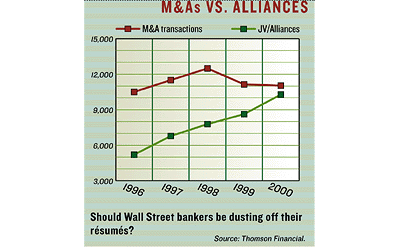
According to Thomson Financial, there were 5,200 new strategic alliances formed in 1996. By last year the number nearly doubled. While mergers and acquisitions--the M&A business so beloved of Wall Street--has garnered the headlines, corporate partnering and other strategic alliances are just as numerous (see chart below). "M&A is a blood sport," says Accenture associate partner Dominic Palmer. "It gets all the press, but strategic alliances are more important for growth."
 |  |
| |
Accenture, the giant consulting firm, pays particular attention to this quiet phenomenon. No wonder: It estimates that U.S. companies with at least $2 billion in revenues each formed an average of 138 alliances from 1996 to 1999.
Strategic alliances aren't new. What is new is the way they are fast becoming the instrument of choice for companies seeking to accelerate growth. Peter Pekar of Houlihan Lokey, Howard & Zukin is coauthor (with John Harbison) of Smart Alliances. Pekar agrees that the corporate world is in the grip of changes of historic proportions.
After World War II the command-and-control business model dominated with its top-down approach. The staff advised, the boss decided. This system nourished the not-invented-here attitude. Increasingly this model is unsuited for today's fast-paced globalized business world. Indeed, the three most important reasons companies form alliances, says Pekar, are growth, access to competencies like technology, and expansion into new markets. E-mail, file-sharing and Web-based conferencing and collaboration tools make alliances across corporate boundaries workable.
For years business tried to solve the problem of growth with mergers and acquisitions. What you lacked you could acquire. This was a bonanza for Wall Street's dealmakers, but most mergers don't work. All too often the best of the acquired assets are soon e-mailing résumés to prospective new employers. In the 1980s M&As were sometimes cheap enough to be worthwhile, but not so in the 1990s with the Dow at ten times its early 1980s level. In the 90s M&As were often ruinously expensive in terms of debt accrued, cash depleted and equity diluted.
Back to Coca-Cola. For years Coke was killed in snacks and noncarbonated drinks by Pepsi (nyse: PBG - news - people). Coke Chairman Doug Daft's first response was the traditional one: He tried to buy Quaker Oats (nyse: OAT - news - people), maker of the highly successful sports drink Gatorade. With Gatorade he would buy the competencies Coke lacked.
But when Warren Buffett and other members of Coke's board saw the $16-billion price tag last year, they rebelled. Daft went back to the drawing board, and the partnership with P&G, announced in March, was the result.
Into the 50-50 joint venture, Coke is putting drink brands like Hi-C and Fruitopia. P&G puts in Pringles chips and healthful noncarbonated drinks like in Sunny Delight. P&G also tosses in a new GrowthPlus vitamin fortification technology and 1,300 other patents. The partnership will start off with sales of $4 billion.
An early dividend from the joint venture will come soon when Pringles chips are offered to Coke's 16 million outlets.
As the appointment of Steven Heyer suggests, this isn't going to be Coke's last such alliance. Heyer is an outsider who comes to the Atlanta-based company by way of Booz, Allen then Young & Rubicam and was most recently president of Turner Broadcasting Systems. Heyer is the first outsider to be hired as an operating president in more than 20 years. "My title," he says, "is president of new business ventures, but I am also in charge of strategic planning and marketing for all of Coca-Cola. This is not by accident." Indeed it isn't. Strategic alliances are now likely to be the cornerstone of Coke's growth strategy.
Thus Coke is also expanding its longtime iced-tea alliance with Nestlé S.A. A new jointly managed company called Beverage Partners Worldwide will offer new products in the growing "rejuvenation" category of ready-to-drink coffees, teas and herbal drinks. Both operations will report directly to Heyer.
"For a longtime some products in Coke's pipeline were hamstrung. Not every product should go through our bottlers," says Heyer. "My job will be to help the joint ventures produce results in as short a time as possible."
This wouldn't be a powerful trend if only Coke was involved. But so are many other top U.S. companies. A recent convert to the power of alliances is the ailing, $37-billion Kmart (nyse: KM - news - people), in Wal-Mart's shadow for decades. One of Wal-Mart's overwhelming advantages is its efficient buying and inventory system. With its sagging stock price and $3 billion of debt, there is no way Kmart could build a system that good.
So in February Kmart announced a $4.5 billion supply-chain alliance with grocery wholesaler Fleming (nyse: FLM - news - people), which recently centralized its procurement and distribution system with the latest technology. Fleming will integrate Kmart's buying, inventory control and logistics with its own. A joint team will be based in Kmart headquarters working with line managers to save money--some $400 million is hoped for in the first three years. Wal-Mart aside, the alliance will allow Kmart to go head-to-head with grocery chains.
Of course, strategic partnering isn't new. Dow Corning was formed in 1943 by Dow Chemical (nyse: DOW - news - people) and Corning Glass Works to market a jointly produced substance called silicone through an independent company.
Joint ventures can grow into valuable assets. Last month Xerox (nyse: XRX - news - people), desperate for cash, was able to sell half its 50% stake in a 39-year-old joint venture, Fuji Xerox Co., to partner Fuji Photo Film. Xerox remains a 25% partner; it pocketed $1.3 billion in much-needed liquidity at a time when the capital markets had closed down for the copier company.
Globalization is a major force behind partnering. When Wal-Mart wanted to expand in Mexico in anticipation of Nafta, it formed a joint venture with Mexico's Cifra. Cifra gave Wal-Mart a firm base and greatly shortened its learning curve about the Mexican market. Cifra/Wal-Mart is now Mexico's leading retailer under the name Wal-Mart de Mexico, and Wal-Mart has a 60% stake. Wal-Mart has taken that experience and applied it to Brazil and other parts of Latin America.
Technology, too, facilitates strategic alliances, with the World Wide Web serving as the network linking child to parent and parent to parent. It's no accident that high-tech companies like IBM, Cisco (nasdaq: CSCO - news - people), Microsoft (nasdaq: MSFT - news - people), AOL (nyse: AOL - news - people) and Intel (nasdaq: INTC - news - people) led the way in creating strategic alliances: the Internet makes alliances across political and corporate boundaries much easier. "For many established companies, the Web has legitimized alliances," says Charles Roussel, director of Accenture's global alliance practice.
Certainly IBM is an enthusiastic convert. Throughout its history IBM engineers built their own hardware and software platforms, from the IBM PC to OS/2 and the AS400. IBM was proudly self-sufficient. Louis V. Gerstner changed all that when he blew into the company in 1993. He had come from American Express Travel and RJR Nabisco, companies that relied heavily on outside distribution channels. "It was hard for me to imagine doing business any other way," said Gerstner in a recent speech.
Today IBM is at the forefront of strategic alliances. In Building 1 of its glass-and-steel complex in Somers, N.Y., IBM software alliance guru Robert Timpson and his team of facilitators sit in the "war room" and survey a wall covered with procedural charts of 59 strategic software alliances. Timpson monitors each strategic alliance from a Lotus Notes extranet he keeps on his laptop.
Timpson explains the advantages of partnering for IBM: "Our brand has always been associated with trust, integrity, reliability. Unfortunately, we are not always viewed as the hottest, coolest or fastest to a programmer from Berkeley." The alliances bring the hot, the cool, the fast where IBM needs it.
The alliances are the key to IBM's growth strategy. Partners get access to IBM's 177,000-person global sales force and service providers. IBM gets the partners' promise to adapt their software to IBM's mainframe and middleware platforms.
Is it working? You bet. IBM wants to nearly double its strategic software alliances to more than 100 partners by year-end.
Partner or die. Yet the sad fact is, most American companies still don't get it. The older industries--financial services, forest products, metals and retailing--are still operating in a buy-and-build, command-and-control mentality. Even with Coke, alliance-builder Heyer admits he will need to create a staff of alliance evangelists to preach the gospel of partnering.
This is, of course, good news for management consultants who have established practices to help companies arrange intercorporate alliances. Conversely it may be bad news for Wall Street bankers who have waxed wealthy from mergers and acquisitions but have little to offer in forming partnerships.
In many ways, partnering is relatively uncharted territory. It isn't much taught in most management schools. There are a lot of unknowns and potential pitfalls. "You can't run a successful alliance practice with lawyers. Alliances are about means. Contracts are about ends," says Roussel.
As a discipline, partnering is still underdeveloped. Adds Roussel: "We are beyond the stage of convincing companies that alliances are needed for external growth. Unfortunately, most alliances are left to the corporate finance guy in the business development department. That's wrong. This is a core competency and it needs to be addressed at a strategic level."
And Peter Drucker points out that many partnerships will face the real test after they have achieved initial success. Once the money starts coming in, goals change and partners often squabble. So be it: The trend seems unstoppable.
Cross Reference http://c2.com/w2/bridges/CorporatePartnering

 -- JohnDeBruyn - 15 May 2001

| I | Attachment | History | Action | Size | Date | Who | Comment |
|---|---|---|---|---|---|---|---|
 gif gif |
chartmavsalliances.gif | manage | 29.7 K | 2001-05-16 - 02:14 | UnknownUser | Chart of Mergers and Acquistions vs. Alliances |
 Edit | Attach |
 Topic revision: r1 - 2001-05-16 - JohnDeBruyn


 Site map
 Blog web

 Create New Topic
 Index
Index Search
 Changes
 Notifications
 RSS Feed
 Statistics
 Preferences


 Account




 Ideas, requests, problems regarding TWiki? Send feedback. Ask community in the support forum.
Copyright © 1999-2026 by the contributing authors. All material on this collaboration platform is the property of the contributing authors.