Notes
I just needed to keep some notes persistent so I could access them from anywhere, I doubt this page will be of interest to anybody.
Medicine Notes JNDI Java Script Some Java Notes Commonly Lost Links Calculus NotesCalculus Notes
- Closed Interval [a,b] a <= x <= b , "x is between a and b"
- Open Interval (a,b) a < x < b , "s is strictly between a and b"
- open interval (a,
) the set of all real numbers x greater than a - open interval (-
, a) the set of all real numbers x less than a - open interval (-
, ) the set of all real numbers, or the real line R
- open interval (a,
- Half open interval [a,b) a <= x < b
- Half open interval [a,
) a <= x - Real Number sets
- Empty set phi
- finite set {a1,... an}
- Set N {1,2,3,...} the set of all positive integers
- the set Z {..., -3, -2, -1, 0, 1, 2, 3 ...} set of all integers
- The set Q of all Rational Numbers.
- Rational Numbers: A rational number is a quotient m/n such that m and n are integers and n = 0
- Ordered pair of real numbers (a,b) coordinates of a rectangle and is completely different from the open interval we discussed above
Medicine Notes
Among patients with PAF, a Cox regression model found that the only factor that predicted embolic complications was the development of chronic AF [42]. Interestingly, the number of paroxysms of AF was not a significant risk factor.SWAN GANZ
- Wear the Head cape and the mask
- Make sure the bed railing is down and the head of the patient is also down
- Put on the top lights
- Make sure the patient is comfortable and keep on informing the patient on each step of the procedure about what you are doing and let him know before each prick
- Scrub
- Wear a pair of gloves and scrub the target region
- Wear your gown
- Dispose off the old unsterilized gloves and put on a new pair of sterilized gloves
- Ask your helper to give you the sheets and put them around the patient yourself at the same time remember to make the sheet that goes over the patients face into a triangle so that the far side of the patients face is uncovered
- Ask your helper to get the kit for the central line
- Ask him to open the outer covering and pick up the blue colored cloth on top of it and place the kit over the patient on the sheets
- Take one of the 5cc syringes from the tray and attach one of the large bore needles to it. Take the lidocaine ampoule and break it in your hands the ampoule can be held upside down. Put in the large bore needle and draw in the lidocaine
- Change to a small bore needle
- Inject the lidocaine while going parallel to the skin under the clavicle at the junction of the lateral head of the sternocleidomastoid immediately below the clavicle. The approach should be aimed at the suprasternal notch. You will not puncture the subclavian with this needle because this is pretty small. Now start pushing in the lidocaine but before each push you must withdraw the plunger to make sure you don’t inadvertently give an intravenous of lidocaine. Start withdrawing the needle slowly while pushing in the lidocaine, but again remember to withdraw the plunger before each push.
- Take out the needle
- Take hold of the large needle used to get into the subclavian vein and add a 5cc syringe to it.
- Now take the same approach as I described earlier to get into the subclavian.
- When you get into the subclavian withdraw some blood into the syringe and get rid of it. You can drop the blood into the tray or on the sheet. You may even reuse the syringe for next time or dispose it, but remember to place the sharp into the needle holder.
- Now pick up the threading wire and while holding the needle in between the index and the middle finger and the wire in between the thumb and the ring finger insert the curved end of the wire. Keep the threading wire rolled in your other hand.
- Remember don’t push if you feel any resistance, try turning the needle and then try repeating the push. If you can’t get it in the first time pull out the needle a little and try again if you lose the subclavian which you can confirm by drawing blood into a syringe pull out the needle and reinsert the tract is already there.
- Once in know the amount of distance there is to the right atrium. You don’t need to go in there but close to it. Remember if you start seeing PVC’s which you can know by the monitor beeping, you have gone too far down into the right ventricle withdraw gently and it should stabilize.
- Now hold the wire with the right hand and the needle in the left and pull out the needle making sure you don’t let the wire move.
- Stick the needle into the needle holder
- Take the scalpel from the tray and with the cutting edge pointing upwards make a nick the size of about 2/3ds of the blade of the scalpel at the point of insertion
- Now take the dilating needle it is the blue colored plastic needle and push it over the guide wire making sure the guide wire does not move while you are attempting this. Go in all the way as far as the needle will go. Once you are all the way in draw out some blood to make sure you are at the right place.
- Now withdraw it, the path is now dilated. Take hold of the line, the white colored one that is the one with the swivel i.e. the straw like spiral and thread it over the dilator.
- Push in the line along with the dilator stuck into it thru to the subclavian, now withdraw some blood to make sure you are at the right place.
- Take out the needle
- Now withdraw the dilator and put it into the tray
- Now flush the line with heparin
- Suture the line to the skin. You will need to put two sutures
- Goes thru the skin tied to it with one end much longer than the other. The one that remains close to the skin should be about 10cm. Use the longer end to wind around the groove and then tie both the ends together.
- The other suture goes into the skin and is passed thru the eyehole. Make sure to give lidocaine before you apply the stitch.
- Ask somebody to open and bring the long sheet for starting process of inserting the swan ganz .
- Open the sheet and spread the sheet over the patient, it must cover the patient from the head to the toe. Spread the sheet on your side and over the other side making sure the patient is completely covered. Make sure your side is completely covered. The swans is large and it is going to be all over the place.
- Change your gloves and also ask the helper to change his gloves. Remember always be polite. GoPolitely.
- Ask somebody to get the swans.
- Take the swan and place over the sheet while still in it’s final tray.
- Make sure to put the sleeve on the swans before doing anything else.
- Flush each of the lumens starting with the most terminal one, one that goes into the pa and measures the wedge. Inflate the balloon to make sure it is patent and leave the syringe attached to it,
- There are multiple lines on the swans. Each small line is at 10cm. At 20 cm there are two small lines. There is a broad line at 50cm.
- Now hand over the lumen side of the SW to the nurse. You will never again touch it. Ask her to connect the catheter to the monitor. Now hit the end of the catheter that is the one that goes into the heart on your other hand and look at the catheter at the same time to make sure there are waves on it when you do that.
- If you get no waves ask the nurse to flush it again and make sure the connection with the monitor is intact and secure.
- Now ask the nurse to inflate the balloon and rapidly push the catheter into the heart while at same time watching the monitor
- When the catheter is in the RA the waves are small and wavy

-
- When the catheter is in the RV the waves become large about 6-8 cm
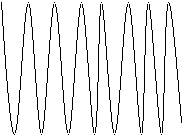
-
- When the catheter goes past the RV into the PA the waves are smaller
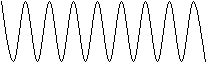
-
- Now slow down and push the catheter in when the catheter wedges the waves become small and broad and sinusoid

- And you are in.
- Take hold of the sleeving and run it to over the line. The sleevings blue end that looks something like this fits into the line’s exposed end.

- Use the small clear tape in the covering of the line to attach the catheter to the sleevings other end.
Adrenal Insufficiency
- Aldosterone secretion primarily is regulated by the renin-angiotensin system, but it also is stimulated by increased serum potassium concentrations.
- More than 90% of cases are attributed to autoimmune disease. Worldwide, the most common cause is tuberculosis (TB).
- Salt craving is another symptom typical of patients with zona glomerulosa dysfunction and may be the first sign of autoimmune adrenal destruction.
- Patients with chronic adrenal insufficiency often complain of fatigue, anorexia, asthenia, weight loss, abdominal pain, nausea, vomiting, and weakness. Patients may have hypoglycemia and most have hypotension. Orthostatic changes in BP and pulse are cardinal signs of adrenal insufficiency.
- Hyponatremia and hyperkalemia are common in primary adrenal insufficiency due to deficient aldosterone secretion. Hyponatremia occasionally is seen in central or secondary adrenal insufficiency, presumably due to water retention from increased vasopressin secretion.
- Death usually results from hypotension or cardiac arrhythmia secondary to hyperkalemia.
Pathophysiology of Syncope
Pathophysiology: Decreased cerebral perfusion is the final common pathway leading to syncope. In some patients, brainstem hypoxia triggers a posturing reflex that can appear seizure-like. A number of cardiac and noncardiac conditions can causes syncope (see "Causes" below). The pathophysiology of neurocardiogenic syncope is interesting and poorly understood. With prolonged standing, the left ventricle may be underfilled. This triggers an increase in inotropy. The forceful contraction stimulates mechanoreceptors, located primarily on the floor of the left ventricle. This mechanical activation triggers a reflex similar to the Bezold-Jarisch reflex, which leads to sympathetic withdrawal and parasympathetic activation. The result is bradycardia (cardioinhibitory), vasodilatation (vasodepressor), or both (mixed response). Other stimuli can trigger a similar autonomic response. The best known response is carotid sinus pressure. Other situational triggers to reflex syncope include cough, micturition, defecation, and deglutition (ie, swallowing).JNDI Notes
Make sure the Java Schema is current openLDAP java schema does not work with the tutorialJavascript Notes
- Commonly, you create a new global variable by simply assigning it a value:
newVariable=5;
- However, if you are coding within a function and you want to create a local variable which only scopes within that function you must declare the new variable using the var statement:
 function newFunction()
 { var loop=1;
   total=0;
   ...additional statements...
 }
- Singletons the methods should not be static. Singleton is same as on object, only the initializer should be static.
- Attributes are instance variables that represent simple values rather than associations for an object, e.g. date of birth is an attribute of a person whereas their employer is an association. To avoid changes through other references when passing attributes around they must be copied, which may incur an inappropriate overhead.
- Immutable Objects
- Make an object's state immutable, i.e. freeze it at construction.
- Provide an intuitive and complete set of constructors whose construction is lightweight.
- By definition the state of an immutable object cannot be changed, and hence will not suffer from undesirable or unpredictable change.
- No need for synchronisation and no race condition problems.
- Sharing without aliasing side effects and therefore no need for copying.
- Change of value is effected by replacement with another object holding a different value.
- The class must be final or any given subclass must also implement IMMUTABLE VALUE.
- More dynamic memory allocation where values are changed often. If this incurs an undesirable overhead, FLYWEIGHT can be applied as an optimisation
- The standard java.lang.String class.
- Functional programming is based on pure mathematical values which are immutable.
- The difference between IMMUTABLE VALUE and READONLY INTERFACE is fundamental: IMMUTABLE VALUE addresses issues related to concurrency and aliasing for objects whose value but not identity is important; READONLY INTERFACE addresses partitioning a class interface into separate interfaces based on method side effects to support finer grained specification of intent. Not only is the intent, motivation and applicability different, but also the resulting context: for example, an IMMUTABLE VALUE class is typically a full implementation and should either be defined as final or must require that subclasses are also subtypes, i.e. they also implement IMMUTABLE VALUE; there is no such consequence for READONLY INTERFACE.
- A note on the Circle-Ellipse problem:
Some Java Notes
Links
Telnet to Paris at Wayne My Sandbox HTML tutorials
JavaScript Tut
Calculus Tutorial
Few Java Best Practices
HTML tutorials
JavaScript Tut
Calculus Tutorial
Few Java Best Practices 

| I | Attachment | History | Action | Size | Date | Who | Comment |
|---|---|---|---|---|---|---|---|
 gif gif |
image001.gif | r1 | manage | 0.5 K | 2002-08-17 - 18:13 | UnknownUser | |
| gif |
image002.gif | r1 | manage | 1.6 K | 2002-08-17 - 18:14 | UnknownUser | |
| gif |
image003.gif | r1 | manage | 0.8 K | 2002-08-17 - 18:14 | UnknownUser | |
| gif |
image004.gif | r1 | manage | 0.8 K | 2002-08-17 - 18:14 | UnknownUser | |
| gif |
image005.gif | r1 | manage | 0.6 K | 2002-08-17 - 18:14 | UnknownUser |

Topic revision: r14 - 2004-03-19 - SandeepRandhawa


 Site map
 Blog web

 Users
Users Groups
 Index
Index Search
 Changes
 Notifications
 RSS Feed
 Statistics
 Preferences


 Ideas, requests, problems regarding TWiki? Send feedback. Ask community in the support forum.
Copyright © 1999-2026 by the contributing authors. All material on this collaboration platform is the property of the contributing authors.