
|

|
StevenJames Green | |||||||||||||
Info:
|
|
Watchlist Changes of StevenJames:
| |||||||||||||
 Change
  disabled on twiki.org
 disabled on twiki.org
 None (empty watchlist)
NOTE: Please use the Sandbox web for testing, thanks!
 .
...
I joined the procession as it made its way to the sacred grove. There, under the shady elms, the ceremony began. The Priest of Romulus himself stepped forward to lead the proceedings, surrounded by his throng of attendants. After one of the attendants had poured incense and wine into a fire burning in his portable hearth, the first victim to be led out for slaughter was a small red dog. There was no need for the customary ropes to ensure that the victim looked compliant and submissive before sacrifice - the poor mutt was wagging its tail and walking at a pace, as if it was out on an adventure.
I know how deadly Robigus can be, and I know that our sacrifices have usually met with success (except for that time three years ago, where the ritual must have been defective in some way), but why is it a young dog that is sacrificed? I just can't help thinking of Lucky, my faithful friend and hard-working sheep dog when I see this helpless creature. Some say that it is to do with the Dog Star, but the Dog Star has its own festival, the Augurium Canarium, where a dog is offered - why do we need to repeat the practice here as well? As I see it, the only requirement is that the offering is rusty in colour: might I suggest instead, then, a colony of red ants?
PRIMARY SOURCES
.
...
I joined the procession as it made its way to the sacred grove. There, under the shady elms, the ceremony began. The Priest of Romulus himself stepped forward to lead the proceedings, surrounded by his throng of attendants. After one of the attendants had poured incense and wine into a fire burning in his portable hearth, the first victim to be led out for slaughter was a small red dog. There was no need for the customary ropes to ensure that the victim looked compliant and submissive before sacrifice - the poor mutt was wagging its tail and walking at a pace, as if it was out on an adventure.
I know how deadly Robigus can be, and I know that our sacrifices have usually met with success (except for that time three years ago, where the ritual must have been defective in some way), but why is it a young dog that is sacrificed? I just can't help thinking of Lucky, my faithful friend and hard-working sheep dog when I see this helpless creature. Some say that it is to do with the Dog Star, but the Dog Star has its own festival, the Augurium Canarium, where a dog is offered - why do we need to repeat the practice here as well? As I see it, the only requirement is that the offering is rusty in colour: might I suggest instead, then, a colony of red ants?
PRIMARY SOURCES
The Farmer and the Dog: Mixed Feelings at the Sacrifice at the Robigalia
The hot sun outside the window reminded me that it was time to appease Robigus, the god of Mildew, so that it would stay away from my corn: it was the seventh day before the Kalends of May, the Robigalia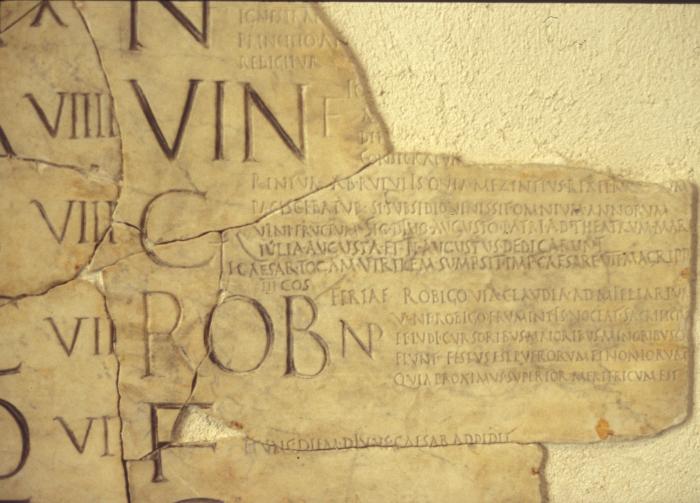 .
...
I joined the procession as it made its way to the sacred grove. There, under the shady elms, the ceremony began. The Priest of Romulus himself stepped forward to lead the proceedings, surrounded by his throng of attendants. After one of the attendants had poured incense and wine into a fire burning in his portable hearth, the first victim to be led out for slaughter was a small red dog. There was no need for the customary ropes to ensure that the victim looked compliant and submissive before sacrifice - the poor mutt was wagging its tail and walking at a pace, as if it was out on an adventure.
I know how deadly Robigus can be, and I know that our sacrifices have usually met with success (except for that time three years ago, where the ritual must have been defective in some way), but why is it a young dog that is sacrificed? I just can't help thinking of Lucky
.
...
I joined the procession as it made its way to the sacred grove. There, under the shady elms, the ceremony began. The Priest of Romulus himself stepped forward to lead the proceedings, surrounded by his throng of attendants. After one of the attendants had poured incense and wine into a fire burning in his portable hearth, the first victim to be led out for slaughter was a small red dog. There was no need for the customary ropes to ensure that the victim looked compliant and submissive before sacrifice - the poor mutt was wagging its tail and walking at a pace, as if it was out on an adventure.
I know how deadly Robigus can be, and I know that our sacrifices have usually met with success (except for that time three years ago, where the ritual must have been defective in some way), but why is it a young dog that is sacrificed? I just can't help thinking of Lucky , my faithful friend and hard-working sheep dog when I see this helpless creature. Some say that it is to do with the Dog Star, but the Dog Star has its own festival, the Augurium Canarium, where a dog is offered - why do we need to repeat the practice here as well? As I see it, the only requirement is that the offering is rusty in colour: might I suggest instead, then, a colony of red ants
 ?
PRIMARY SOURCES
?
PRIMARY SOURCES
- VARRO, On Agriculture, 1.1.6
- VARRO, On the Latin Language, 6.16
- COLUMELLA, On Agriculture, 10.342-4
- AULUS GELLIUS, Attic Nights, 5.12.14
- PLINY, Natural History, 18.285
- OVID, Fasti, 4.901-42
- FESTUS, 39L., 325L., 358L.
- Fasti Praenestini on Apr. 25
- M. Beard, J. North and S. Price (1998), Religions of Rome, Cambridge, I.45-7, II.32
- G. Dumézil (1970), Archaic Roman Religion, Chicago, I.158
- E. Fantham (1998), Ovid Fasti Book IV, Cambridge, 263-72
- J. Scheid (2003), An Introduction to Roman Religion, Indiana
- H.H. Scullard (1981), Festivals and Ceremonies of the Roman Republic, London, 108-10

Topic revision: r7 - 2008-02-19 - PeterThoeny


 Site map
 Blog web

 Users
Users Groups
 Index
Index Search
 Changes
 Notifications
 RSS Feed
 Statistics
 Preferences


 Ideas, requests, problems regarding TWiki? Send feedback. Ask community in the support forum.
Copyright © 1999-2026 by the contributing authors. All material on this collaboration platform is the property of the contributing authors.